
Access to technology is no longer a luxury. For people with low vision or no vision, it’s often the difference between independence and isolation.
That belief sits at the heart of a new initiative led by the Centre for Accessibility (CFA Australia). Through the program, donated laptops are refurbished and provided to people living with disability, set up with the right features required to run assistive software effectively.
VisAbility has been working closely with CFA Australia during the early stages of the program, helping identify individuals who would benefit most from access to reliable technology. Two long‑term VisAbility clients, Lynn and Tamara, are the first to receive laptops, marking the beginning of what CFA Australia hopes will become an ongoing and far‑reaching program.
Identifying the need
The idea behind the program is simple, but powerful. CFA Australia receives donated laptops and prepares them so they can support screen readers and other accessibility tools. VisAbility’s role has been to provide insight into where the need exists, drawing on our Assistive Technology team’s experience working directly with clients.
For many people with vision impairment, funding can cover specialist software but not the hardware required to run it. As a result, people are often left relying on outdated or unsuitable devices – if they have access to a computer at all.
VisAbility Assistive Technology specialists, Ryan Honschooten and David Vosnacos, put forward Lynn and Tamara as ideal candidates for the pilot. Both had the skills and software to use a laptop effectively, but not the means to access suitable hardware.
Tamara: staying connected and finding her voice
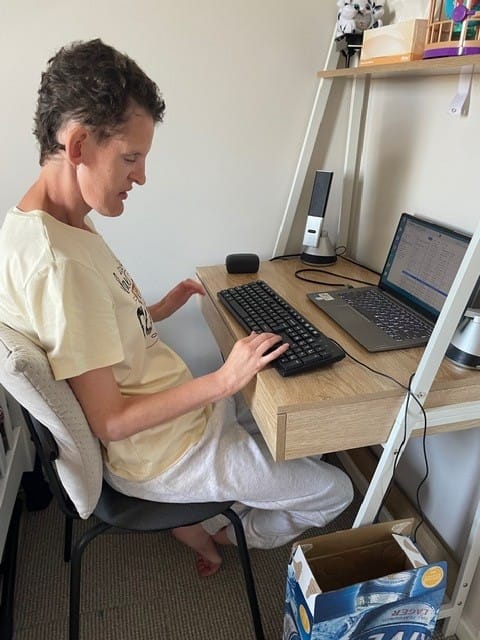 Tamara lives in Harvey and has been totally blind since childhood. A VisAbility client since she was young, she regularly accesses Orientation and Mobility support and Assistive Technology guidance.
Before receiving her new laptop, Tamara was using an old device that could no longer connect to Wi‑Fi and frequently crashed. It made everyday tasks frustrating and unreliable.
The timing of her new laptop couldn’t have been better.
Tamara has recently begun training for her own radio show on Harvey Radio, and the laptop has quickly become an essential part of that process. She uses it for email, research, music, and recording practice — as well as staying in touch with friends and family.
“For vision‑impaired people, it’s really important to stay connected,” Tamara says. “Without that, it can feel very isolating.”
Having access to reliable technology has allowed Tamara to learn, explore new interests, and communicate independently – something she says would have been difficult without the support and guidance she’s received.
Lynn: independence, regained
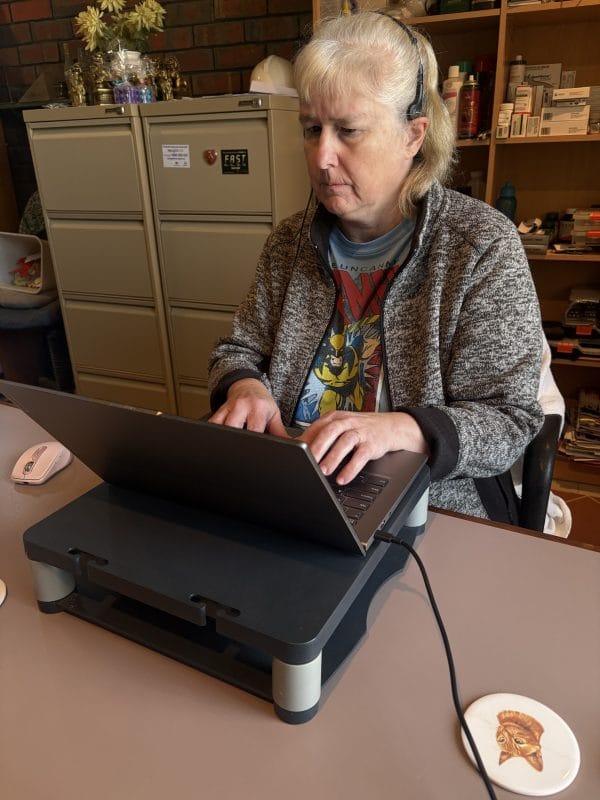
Lynn’s relationship with VisAbility spans decades. Originally from England, she became a client shortly after arriving in Perth in the 80’s and reconnected with us when she returned to WA in 2006.
Over time, Lynn’s vision has deteriorated to the point where she now relies entirely on voice‑based technology. Her previous laptop was slow, outdated, and no longer supported the screen reader she uses. Funding options were limited, and the cost of replacing it was out of reach.
“When my old laptop started failing, I didn’t know what I’d do,” Lynn says. “There are only certain things you can manage on a phone.”
Today, her new laptop plays a central role in daily life. Lynn uses it to write letters, manage emails, scan and read documents, plan holidays, search for work, and stay involved with her church community.
“Being able to communicate on my own has given me independence back,” she says. “It’s one less thing I need to rely on people for.”
That independence is especially meaningful while Lynn waits for her next Guide Dog. With mobility temporarily limited, having accessible technology at home has helped her stay connected and self‑reliant.
More than a device
What makes this program so impactful is that it’s not just about providing laptops. Each device is prepared with accessibility in mind and matched to the individual’s needs, with professional input to ensure it can be used effectively.
For VisAbility staff, the program also addresses a long‑standing challenge – finding suitable devices that meet technical requirements without placing additional financial strain on clients.
For CFA Australia, the goal is to continue growing the program, reaching more people, and connecting with organisations that may be able to donate unused laptops or provide funding support.
Looking ahead
Lynn and Tamara’s stories reflect what can happen when access needs are properly understood and supported.
If you’re a VisAbility client who may benefit from accessible technology, speak with your VisAbility support team. If you’re an organisation with laptops no longer in use, CFA Australia encourages you to get in touch to explore how those devices could make a real difference.
Because access to technology isn’t just about hardware. It’s about connection, independence, and the ability to participate fully in everyday life.