
Yes, we know, there are a lot of ‘O’ words in Vision Services. Don’t worry, it’s not just you! Between Orthoptists, Ophthalmologists and Optometrists (and Opticians if we want to add another), no one can be blamed for getting confused. Today, we want to talk about Orthoptists… but first!
What exactly are all of those?
Look, we’re here to talk about Orthoptists, but there’s no point explaining what an orthoptist does if you don’t know what makes them different from the other Os. So, very quickly, let’s recap.
Ophthalmologists are medically trained doctors. They act as both physicians who diagnose and prescribe treatments, and surgeons who perform operations. If you’ve had eye surgery, you’ve almost certainly met an Ophthalmologist. They provide urgent intervention, as well as help manage severe eye conditions.
Optometrists are university-trained (5 years in Australia!) and are probably the most well-known in this group. They provide routine yearly eye examinations, track and diagnose changes in your vision, and prescribe glasses and contact lenses. Most likely, your optometrist works at the same place you buy your glasses!
And to round us out, an Optician is the person who fits, repairs, and sells your eyewear. They work from the information given to them by your optometrist or ophthalmologist in the form of a prescription. An optician requires a Certificate IV in Optical Dispensing (or equivalent) to operate in Australia.
So, now that we have that out of the way….
What is an Orthoptist?
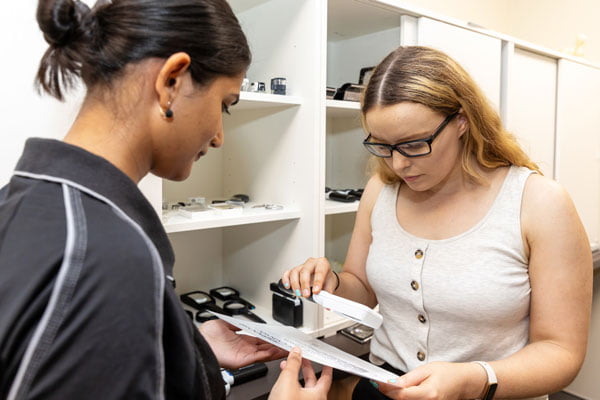
Orthoptists are university-qualified allied health professionals who play an important role in low vision clinics by helping people make the most of their remaining vision. Traditionally, orthoptists were known for working mainly with children to diagnose and manage eye movement problems such as strabismus (eye turn) and amblyopia (lazy eye). However, the profession has expanded significantly, and orthoptists now work across many areas of eye care, including low vision rehabilitation.
In low vision clinics, orthoptists assess visual function in detail, including visual acuity, contrast sensitivity, eye movements, and visual fields. They help people with conditions such as age-related macular degeneration, glaucoma, or diabetic retinopathy learn practical strategies to improve everyday activities like reading, recognising faces, and navigating their environment.
Orthoptists also recommend and provide training with low vision aids such as magnifiers, telescopes, and electronic devices, helping patients feel confident using them in daily life. Through education, rehabilitation techniques, and ongoing support, orthoptists aim to improve independence and quality of life for people living with permanent vision loss.
Ok, but what does an Orthoptist actually do?
There are a couple of different things an orthoptist can help you with.
Firstly, they can supply you with a comprehensive vision assessment. This is different from what you might get through an optometrist, as it considers the functional impact of your eye condition. This can assist you in making a case for support to organisations like the NDIS or Centrelink, as it gives them more context for the real-world impact of your disability. It also allows our Occupational Therapists and Orientation and Mobility Specialists to have a more complete understanding of your practical vision and better tailor their services to your needs.
Secondly, an orthoptist can help you get the most out of your vision that you can. This can be through practical strategies and skills to best utilise your vision. They can also help determine if certain magnification aids and assistive technology would be appropriate and beneficial.
Interesting Orthoptist Facts
Mary Maddox was the first recognised Orthoptist in the world. She was trained by her father, Ernest E. Maddox, a reputed ophthalmologist, and went on to pioneer the profession for years to come. Mary started her own practice in London in the 1920s and opened her first hospital clinic at the Royal Westminster Hospital in 1928.
In Australia, the first hospital to have an orthoptist clinic was Alfred Hospital in Melbourne, which first saw patients in 1931.
Get in Contact Today
If you would like to like to learn more about what our orthoptists can do for you, please reach out to us by email at info@visability.com.au or by phone on 9311 8202.
You can also visit the orthoptics page on our website and complete the enquiry form at the bottom.